


Hope on the Horizon: What Patients Should Know About New Melanoma Research from ASCO 2026
Every year, the American Society of Clinical Oncology (ASCO) meeting brings together researchers from around the world to share the newest findings in cancer care. For people affected by melanoma, these updates can offer something incredibly important: hope.
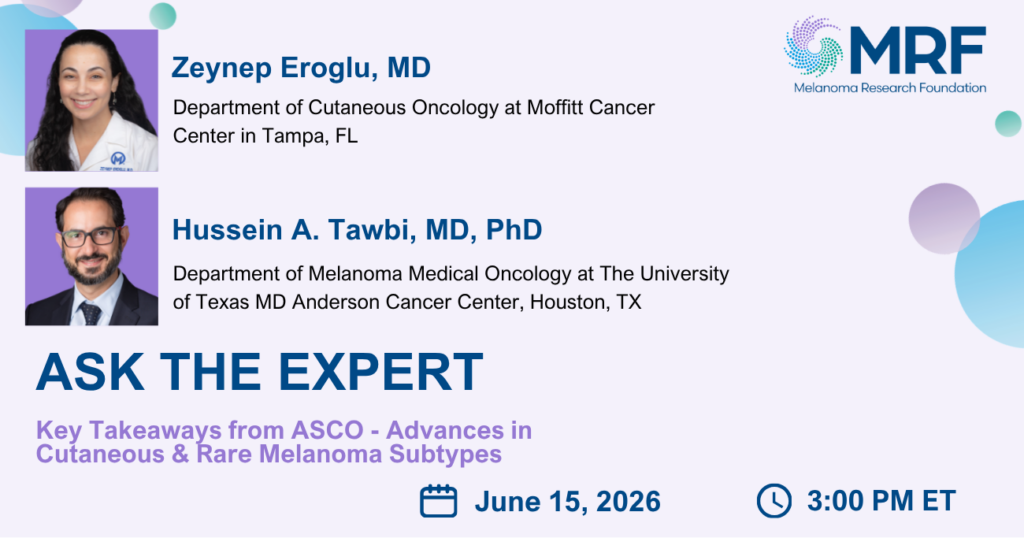
The MRF held a webinar featuring Breakthrough Consortium Co-Chairs, Dr. Hussein Tawbi of MD Anderson Cancer Center and Dr. Zeynep Eroglu of Moffitt Cancer Center, reviewing nine important melanoma studies presented at ASCO 2026. Together, their presentations highlighted a promising message: researchers are continuing to make progress, even for patients whose melanoma has been difficult to treat.
While many of these treatments are still being studied and are not yet widely available, the results show real momentum in several exciting areas, including oncolytic virus therapy, mRNA vaccines, engineered T-cell therapies and new approaches for rare melanoma subtypes.
Why these melanoma research updates matter
Melanoma treatment has changed dramatically over the last decade thanks to immunotherapy and targeted therapy. But there are still major challenges. Some patients do not respond to standard treatments at all, while others may respond at first and later see their cancer return. In addition, rarer forms of melanoma — such as uveal melanoma and mucosal melanoma — often have fewer or no FDA approved treatment options and poorer outcomes.
That is why the studies highlighted in this webinar are so important. Many focused on patients whose disease had already resisted earlier treatments. Seeing durable responses in these groups is encouraging and suggests that new strategies may help fill important gaps in care.
A virus designed to fight melanoma
One of the most talked-about approaches was RP-1, an oncolytic virus therapy. Oncolytic viruses are specially designed to infect and destroy cancer cells while also helping the immune system recognize the tumor more effectively.
In this study, RP-1 was combined with the immunotherapy drug nivolumab in patients whose melanoma had stopped responding to PD-1 treatment. At three years, nearly 48% of patients were still alive, which is especially meaningful in a population with very limited options. Researchers also saw a survival “plateau,” which can suggest that some patients are experiencing a long-lasting benefit.
This is particularly notable because many patients in the study had melanoma that was strongly resistant to prior immunotherapy, and nearly half had already received the combination of ipilimumab and nivolumab. Though initially denied FDA approval in July 2025 and April 2026, RP-1 is now being tested in a phase 3 trial and will be reconsidered by the FDA in the coming months, bringing it one step closer to possible approval.
A personalized mRNA vaccine continues to show promise
Another exciting update involved an individualized mRNA neoantigen vaccine, sometimes called intismeran autogene, used along with pembrolizumab after surgery for patients with stage 3 or stage 4 melanoma.
This treatment is designed specifically for each patient. Scientists analyze the tumor, identify unique markers (called neoantigens), and create a personalized vaccine to help the immune system better recognize and attack melanoma cells.
In earlier results, the vaccine plus pembrolizumab reduced the risk of recurrence by 50% compared with pembrolizumab alone. It also improved distant metastasis-free survival, meaning patients were less likely to develop melanoma that spread to distant parts of the body.
The phase 3 trial has already completed enrollment, and patients and advocates are now waiting for the next set of results. If the findings are found to be positive, this approach could become an important new option in the adjuvant setting — treatment given after surgery to reduce the risk of the cancer coming back.
Engineered T-cell therapies may open new doors
Cell therapy is another area generating excitement. These therapies use a patient’s own immune cells, which are collected, modified or expanded in a lab, and then returned to the body to fight cancer more effectively.
One therapy discussed was anzu-cel, a PRAME-targeted TCR-T therapy. In this early study, the response rate was 50% in cutaneous melanoma and 67% in uveal melanoma, even though all patients had melanoma that had already resisted PD-1 treatment. A key advantage is that the treatment can be made using peripheral blood, meaning it does not require removing tumor tissue through surgery. Manufacturing also takes about two weeks, which is relatively fast for this kind of treatment.
However, anzu-cel currently only works for patients with a specific immune system marker called HLA-A*02:01, so it will not be an option for everyone.
The webinar also covered OBX-115, a newer form of tumor-infiltrating lymphocyte (TIL) therapy. In a small study, about 67% of patients responded, including some with mucosal and acral melanoma, which are often harder to treat. One particularly promising feature is that this therapy may avoid the need for high-dose IL-2, a treatment that can cause significant side effects. Instead, it uses an oral medication called acetazolamide to activate a built-in signal that helps the cells work.
Researchers also noted that OBX-115 may be created from core biopsy samples, rather than requiring full surgical tumor removal. If this approach continues to succeed, it could expand access to cellular therapy for more patients.
New research in treatment before surgery
Several studies looked at neoadjuvant therapy, or treatment given before surgery. This approach is already gaining attention in stage 3 melanoma because it may shrink tumors prior to surgery, help doctors learn how well the treatment is working, and possibly improve long-term outcomes.
In a small study of stage 2 melanoma, patients received nivolumab plus relatlimab before surgery. Remarkably, 60% had a pathologic complete response, meaning no living cancer cells were found in the tissue removed at surgery. Side effects were still important to watch, with 15% experiencing serious toxicities, but the study suggests this strategy may be feasible in stage 2 melanoma as well.
Another neoadjuvant study used a more intensive combination of ipilimumab, nivolumab and relatlimab in patients with stage 3 or 4 melanoma. The pathologic complete response rate was 63%, which is encouraging. At the same time, the study also raised concerns about safety, including one death from myocarditis, a serious inflammation of the heart. This is an important reminder that while more aggressive treatment may produce stronger responses, it can also come with greater risk.
Encouraging progress for melanoma that has spread to the brain
Melanoma brain metastases can be especially difficult to treat, so updates in this area are closely watched. Researchers presented results on next-generation BRAF/MEK inhibitors designed to better reach the brain.
In heavily pretreated patients who had already received earlier BRAF/MEK therapies, the combination of clatrofinib and pomeretinib produced a 26% response rate overall and a 33% intracranial response rate in evaluable brain metastases.
These findings are still early, but they suggest that newer targeted therapies may help some patients even after standard BRAF/MEK drugs stop working.
Rare melanoma subtypes remain a major focus
For people with uveal melanoma, one of the most encouraging updates came from a study of darvasertib plus crizotinib. In patients with metastatic disease who were HLA-A*02:01 negative, the pill combination led to a median progression-free survival of 7 months, compared with 3.1 months for immunotherapy. The objective response rate was also much higher: 37% versus 6%.
These results suggest that this combination could become an important first-line systemic treatment option for a group of patients who currently have very limited choices.
For mucosal melanoma, the news was more mixed. A study of a bispecific anti-PD-1/CTLA-4 therapy plus anti-VEGF axitinib showed a 35% response rate, but it did not appear meaningfully better than the current standard of ipilimumab plus nivolumab. While disappointing, this finding is still valuable because it helps researchers better understand which approaches may or may not move the field forward.
What patients should take away from all of this
The biggest message from ASCO 2026 is that melanoma research is moving forward on many fronts at once.
Researchers are not only trying to improve treatment for common forms of melanoma — they are also working on better options for:
– people whose melanoma has stopped responding to immunotherapy
– patients with brain metastases
– and those with rare melanoma subtypes like uveal and mucosal melanoma
At the same time, it is important to remember that many of these studies are still early-phase trials. Some enrolled only a small number of patients, and several treatments are not yet approved. Promising results do not always translate into standard care right away. More testing is needed to confirm who benefits most, how long responses last, and what side effects patients may face.
Support and resources from the Melanoma Research Foundation
The webinar also highlighted practical resources available through the MRF for patients and families, including:
– 7 animated learning modules to help explain melanoma and treatment options
– Free downloadable educational materials for patients, caregivers, providers and community events
– A no-cost clinical trial finder
– Patient symposia in cities across the United States
– Advocacy opportunities at both the state and national level.
For patients trying to make sense of a fast-changing treatment landscape, these resources can be incredibly helpful.
Looking ahead
One of the most meaningful ways to help move the field forward is through clinical trial participation, when appropriate. Clinical trials are how new treatments become tomorrow’s standard of care.
For anyone living with melanoma, the pace of research can feel overwhelming — but it can also be empowering. Each new study adds to a growing body of knowledge, and each breakthrough brings the melanoma community closer to more effective, more personalized and more durable treatments.
If you have questions about clinical trials or educational resources, the MRF encourages patients and caregivers to reach out to education@melanoma.org and to follow their newsletters and social media for the latest updates.